
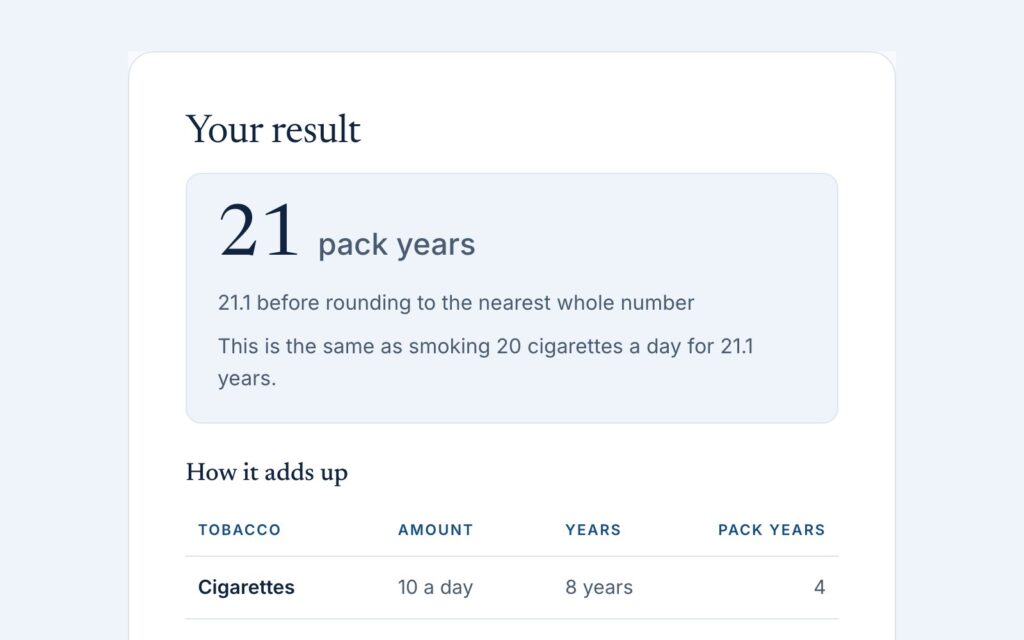
A new version of the smoking pack year calculator went live on 14 October 2026. It works out pack years in exactly the same way as before, but takes you through a smoking history one step at a time and does more with the result.
Has the calculation changed?
No. The conversion figures and the arithmetic are the same as in the original calculator (see the References). Before launch, the new version was tested against the original on 20,000 random smoking histories, and every result matched.
What is new?
- One step at a time: tick the types of tobacco smoked, then answer a short step for each.
- Every type can have more than one period, so cutting down, stopping and restarting can all be entered. The old form allowed this for cigarettes only.
- Cigars and spliffs are now separate choices, each still counted as 4 cigarettes, and loose tobacco can be entered in grams or ounces a week.
- A running total as you type, and an optional step for your smoking history: whether you still smoke, when you stopped and how many years you smoked.
- The result shows how much each type of tobacco adds, and the figure before rounding.
- You can download the result as a PDF, email it to yourself, print it, or save a link to come back to it.
- It is designed for phones first, with a number keypad for every figure.
What is new for clinicians?
A clinician mode gives a line ready to paste into the patient record, with room for your own reference (no patient name), a PDF to attach and a print layout for the consulting room. Practices and screening services can also show the calculator on their own website. The For clinicians page explains both.
What happens to the information I enter?
Nothing you type into the calculator is stored. The PDF is created when you ask for it and is not kept. If you email the result to yourself, it is sent once and your name and email address are then deleted, unless you also tick the box for occasional news. The privacy policy has the details.
How widely is the calculator used?
In 2020 Dr Masters reported in the British Journal of General Practice that the free calculator had been used over a million times (Br J Gen Pract 2020;70(694):230).
Try the new calculator. If you have comments on it, please contact us.