
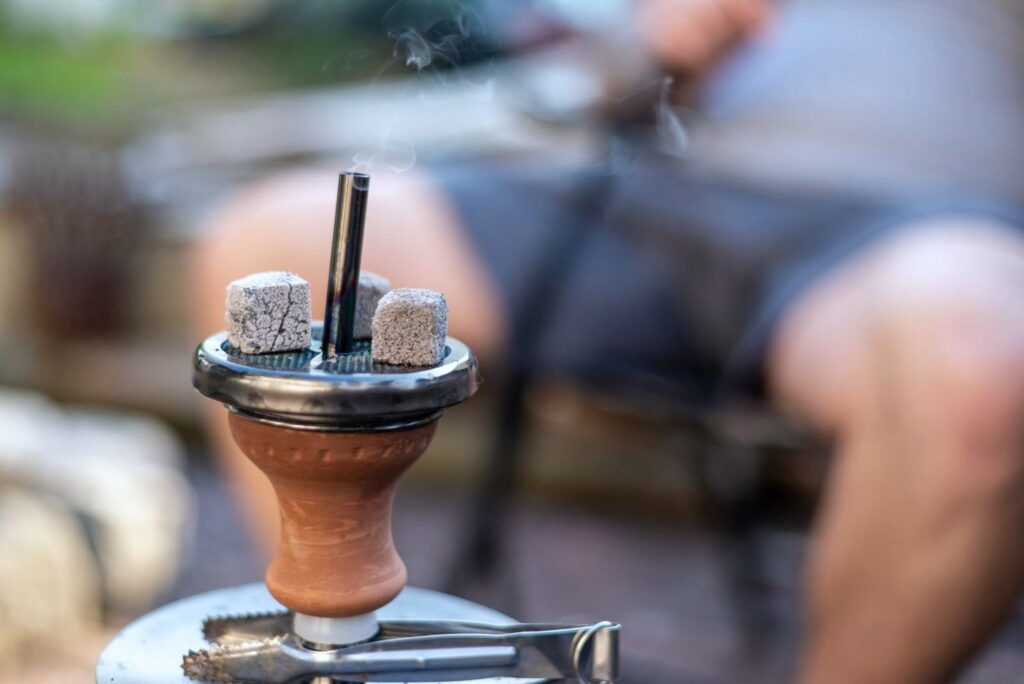
Many people who smoke shisha or bidis may answer “no” when asked “do you smoke?”. A 2012 editorial in the British Journal of General Practice noted that many shisha smokers do not believe they are smoking tobacco, so may not mention it. Asking about each type of tobacco by name helps bring this history to light.
Why might shisha and bidis go unmentioned?
The editorial, Shisha guidance for GPs: eliciting the hidden history (Jawad, Khaki and Hamilton, 2012), pointed out that GP record templates prompt clinicians to ask about cigarette smoking. A patient who smokes a waterpipe at weekends can truthfully say they do not smoke cigarettes, and their tobacco use stays off the record.
How people see shisha matters too. In a qualitative study of students in England and Canada (Roskin and Aveyard, 2009), waterpipe smokers saw it as a communal, novel activity. With one exception, they did not link it in their minds to other forms of smoking, and reasoned it was probably safe because they had seen no health warnings.
There is much less UK research on bidis. In a 2026 survey of 96 professionals involved in smoking cessation support in England, only 33.3% said they were aware of bidis, compared with all of them for shisha.
Who smokes shisha and bidis?
The NHS website describes bidis as “thin cigarettes of tobacco wrapped in brown tendu leaf” and says shisha is also known as a waterpipe or hookah. It states that smoking raises the risk of cancer, heart disease and respiratory problems whether you smoke cigarettes, bidi or shisha.
- Shisha: online surveys of around 12,000 adults in Great Britain in each of 2012 and 2013 found that 11.6% had ever used a waterpipe and 1.0% used one at least once or twice a month. Ever use was more likely among men, younger adults, people who had smoked cigarettes, and people of Asian or mixed ethnicity.
- Bidis: a Lancet analysis of national tobacco surveys reported that bidis were commonly used in India and Bangladesh, and Datta and colleagues report that 73% of smoked tobacco in India is in the form of bidis. We have not found a reliable figure for bidi use in the UK.
How might a clinician ask?
These are practical suggestions rather than formal guidance. The 2012 editorial argued that specifically asking about shisha during consultations may well uncover significant smoking exposure.
- Ask about each type by name: cigarettes, roll-ups, cigars, pipes, bidis, shisha (waterpipe or hookah) and cannabis, rather than only “do you smoke?”.
- Ask about the past as well as now, including any time spent living abroad.
- For shisha, ask how long a typical session lasts and how many sessions a week. For bidis, ask how many a day.
- Ask whether a waterpipe was shared. The calculator asks people to count the whole session, not just their share. Dr Masters’ view is that a shared session counts in full for each person.
- Record the answer as pack years, not just “smoker” or “ex-smoker”. Our page on working out your smoking history can help patients prepare, and there is more for professionals on the clinicians page.
How does the calculator count bidis and shisha?
The calculator converts each type of tobacco into cigarettes, then works out pack years as cigarettes a day multiplied by years smoked, divided by 20. The calculation page explains this in full.
- Bidis: each bidi counts as half a cigarette. This is a rounding of the figure proposed by Datta and colleagues in Lung India (2022): 43 bidis a day for a year equals one cigarette pack year, about 0.47 of a cigarette per bidi. See our bidis page.
- Shisha: each 20-minute session counts as 25 cigarettes. A 2005 WHO advisory note says sessions typically last 20 to 80 minutes, and that a smoker may inhale as much smoke in one session as a cigarette smoker would from 100 or more cigarettes. The calculator takes 80 minutes as 100 cigarettes. Sessions are entered per week and divided by 7. See our waterpipe (shisha) page.
In a 2012 letter to the BJGP, Dr Masters, Catherine Tutt and Nisar Yaseen explained that because shisha is smoked both alone and in groups, the calculator uses a 20-minute session as its baseline.
A worked example. A patient who says they do not smoke has, in fact, smoked shisha for about two hours a week for 14 years.
- Two hours is six 20-minute sessions, so 6 x 25 = 150 cigarettes a week.
- 150 / 7 = about 21.4 cigarettes a day.
- Over 14 years: 150 / 7 x 14 = 300.
- 300 / 20 = 15 pack years.
How exact are these figures?
They are approximations. Published estimates vary widely: the 2012 editorial suggested 10 cigarettes per shisha session, while the calculator’s figure follows the WHO note. Our references page says plainly that this is not an exact science and approximations have been made. The calculator does not ask about bidi size or how much tobacco goes into a waterpipe. A pack year figure describes past smoking; it is not a diagnosis.
If you or a patient have smoked bidis, shisha or any other tobacco, the free Smoking Pack Years calculator will add them together and give a total you can save, print or share with your GP practice.